AirTag vs GPS Tracker for Cars: Which One Actually Works? 2026
-
01
AirTags find lost items through nearby iPhones, not moving cars.
-
02
Cellular GPS trackers report their own location, as often as every 3 seconds.
-
03
AirTag anti-stalking beeps and phone alerts can expose the tag in a stolen car.
-
04
Three years costs $29 for an AirTag, $400 or more for GPS.
-
05
AirTag for keys and bags, GPS for your car.
Wondering what a real car tracker looks like?
TSD's GPS trackers report their own location, so your map keeps moving even when no iPhone is around.
This article contains affiliate links. As an Amazon Associate, Tracking System Direct earns from qualifying purchases.
The AirTag vs GPS tracker debate gets real the moment you open Find My and the pin sits in an empty driveway. Last seen 3:12 a.m., it says. Now it is 6:40, your coffee is still hot, and the spot where your car belongs is bare pavement.
You paid $29 for that tag. So why is the map frozen, and why is the car nowhere on it?
I'm Ryan Horban, and after 15 years of installing GPS trackers on cars, trucks and trailers, I can tell you the tag did exactly what Apple designed it to do: find lost keys, not follow a moving car.
In this guide, I compare both devices side by side, show what each one displays in the first 60 minutes after a theft, and break down the three-year cost, so you can choose before you ever need it.
Use a cellular GPS tracker to protect the car, and keep the AirTag for keys, bags and luggage. AirTags rely on passing iPhones, they beep when separated from their owner, and they give you a stale pin instead of a live route.
I'm Ryan Horban, a GPS tracking specialist, and my answer is simple: an AirTag finds lost items, and a cellular GPS tracker protects a vehicle. At TrackingSystemDirect, I point car owners to a tracker that reports its own location over a cellular network, either a hidden battery unit like SpaceHawk, an OBD2 plug-in like Konnect, or a hardwired unit with starter disable. Keep the AirTag on your keys.

See Every Move Live, Not a Last-Seen Pin
Cellular GPS trackers send their own position, so your map keeps moving without a stranger's phone nearby. Pick from hidden battery, OBD2 and hardwired models.
- Real-time updates
- No Bluetooth dependence
- Hidden, OBD2 and hardwired options
- iPhone and Android apps
Is an AirTag a GPS Tracker?
No. AirTags are Bluetooth item finders with no GPS receiver and no cellular radio, so they depend on nearby Apple devices to report where they are.
The difference sounds small on paper. In a stolen car, it decides whether you see a route or a dot that stopped moving hours ago. How each device finds your car comes down to who does the work.
How an AirTag Finds Your Car
AirTags send out a short-range Bluetooth signal. When any iPhone, iPad or Mac on Apple's Find My network passes close enough, that device quietly relays the tag's position to Apple, and the owner sees it in the Find My app. The tag does the shouting, and strangers' devices do the reporting.
On a busy street, that works well. Parked in a driveway at 3 a.m., or driven down a rural road, the tag may have no Apple device in range for long stretches, so the pin sits still while the car moves on.
Cellular trackers take the opposite approach.
How a GPS Tracker Finds Your Car

Cellular GPS trackers carry their own GPS receiver and their own SIM card. They work out their position from satellites, then send it to your phone over a cell network, with no help from anyone else's device. TSD's SpaceHawk can update as fast as every 3 seconds, and Konnect, which plugs into the OBD2 port, updates every 3 seconds as well. Konnect includes the first full year of service, then costs $8.95 per month.
Cell coverage becomes the limit instead. One Konnect customer review calls the signal "hit or miss" in rural West Texas, even though the unit held up. Dead zones exist, but a tracker with its own cellular radio does not need a passing stranger to report in.
Apple did update the tag this year, so the 2026 version deserves a fair look.
What Changed With the 2026 AirTag
Apple announced the second-generation AirTag on January 26, 2026. According to MacTrast's report on Apple's announcement, it adds a second-generation Ultra Wideband chip and three upgrades worth knowing. Pricing stayed at $29 for one and $99 for four.
-
Precision Finding
Works from up to 50% farther away than the original AirTag.
-
Louder speaker
A speaker 50% louder than the first model.
-
Better Bluetooth range
Improved range outside Precision Finding mode, with no figure given.
Those upgrades help you find a tag that is near you, like keys under a couch cushion or a bag in a parking structure. The tag still has no cellular radio and no GPS receiver, so it still needs a passing Apple device to report a car that is miles away. Louder speakers also make a hidden tag easier for a thief to find, which comes up again in the detection section below.
Before comparing the two directly, it helps to know how much is at stake.
How Often Are Cars Stolen, and How Many Come Back?

Roughly 660,000 vehicles were stolen in 2025, and most stolen cars are eventually recovered, many within two days.
How Often Cars Are Stolen
The National Insurance Crime Bureau (NICB) reported on March 18, 2026 that 659,880 vehicles were stolen nationwide in 2025, a 23% decrease from 2024. Even after that drop, NICB says one vehicle is still stolen every 48 seconds.
The drop is good news. Even one theft every 48 seconds means somebody's driveway is empty right now, and every one of those owners starts with the same question: where did it go?
NICB's own vehicle theft prevention tips even list aftermarket GPS tracking, with AirTags named as an example, as one way to make a stolen car easier to find. The open question is what a tag can and cannot do once the car is moving.
Finding the car again is the usual outcome, but the clock matters.
How Often Stolen Cars Are Recovered
NICB's 2023 Vehicle Theft Trends Report found that more than 85% of stolen passenger vehicles were recovered. About 34% came back within a day of being reported stolen, and 45% within two days.
Those numbers say recovery is the usual ending. How fast it happens depends on what you know in the first hours, which is exactly where the two devices split apart. The table below lines them up on the points that matter most.
AirTag vs GPS Tracker: Side-by-Side Comparison
Eight features separate an item finder from a vehicle tracker. Check the rows that match your worry, then read the notes underneath.
| Feature | AirTag | Cellular GPS tracker |
|---|---|---|
| Technology | Bluetooth plus Apple's Find My network | Built-in GPS receiver plus a cellular SIM |
| Real-time updates | Only when an Apple device passes nearby | Up to every 3 seconds (SpaceHawk, Konnect) or every 30 seconds (hardwired model) |
| Range | Short-range Bluetooth, stretched by passing Apple devices | Anywhere with cell coverage |
| Anti-stalk beeping | Yes, plays a sound and can alert nearby phones | None built in |
| Upfront cost | $29 ($99 for four) | $39.95 to $249.95 on TSD (sale prices) |
| Monthly fee | None | About $9 to $15 on TSD after any included period |
| Battery | Replaceable coin cell | SpaceHawk averages 2 to 3 weeks, up to 6 months in low-power mode; OBD2 and hardwired models draw vehicle power |
| Best for | Keys, bags, luggage | Cars, trucks and anything you need to follow live |
One row in particular, anti-stalk beeping, deserves a closer look.
Can Car Thieves Detect an AirTag?

Yes. AirTags are built to be found by the person being tracked, so a thief can learn about one through a sound, a phone alert or a manual scan.
Apple designed those safeguards to protect people from being tracked, and they do that job well. In a stolen car, the same safeguards work against you.
How a Thief Can Find an AirTag
Apple's support page describes the routes. Once an AirTag has been away from its owner for a period of time, it plays a sound when it moves. iPhones can show an "AirTag Found Moving With You" alert when a tag travels with them over time. Android phones running version 6.0 or later can alert automatically, and Google's Tracker Detect app can run a manual scan, according to Apple Support.
In this business, I treat "the thief has a smartphone" as a given, not a long shot. Apple does not publish an exact delay for the sound, so I would not count on a tag staying quiet for hours.
Cellular trackers sidestep that problem by design.
Why a GPS Tracker Stays Silent
Cellular GPS trackers are not designed to play sounds or send alerts to nearby phones the way AirTags are. Nothing tells a thief to look, so placement does the protecting. Magnet-mount units like SpaceHawk can go on a hidden steel surface under the car, and hardwired units sit behind the dash or panels.
Silent does not mean flawless. Battery units need a recharge every few weeks, and a hidden tracker only helps if the battery is alive when the theft happens.
All of this applies to your own vehicle. Putting a tracker on a car you do not own or share title for can break the law in many states, and the rules differ widely.
Tracking laws change from state to state. GPS Tracking Laws by State shows what applies where you live before you place a tracker.
Read guideIf you want the silent, hidden option, this is the one I would look at first.
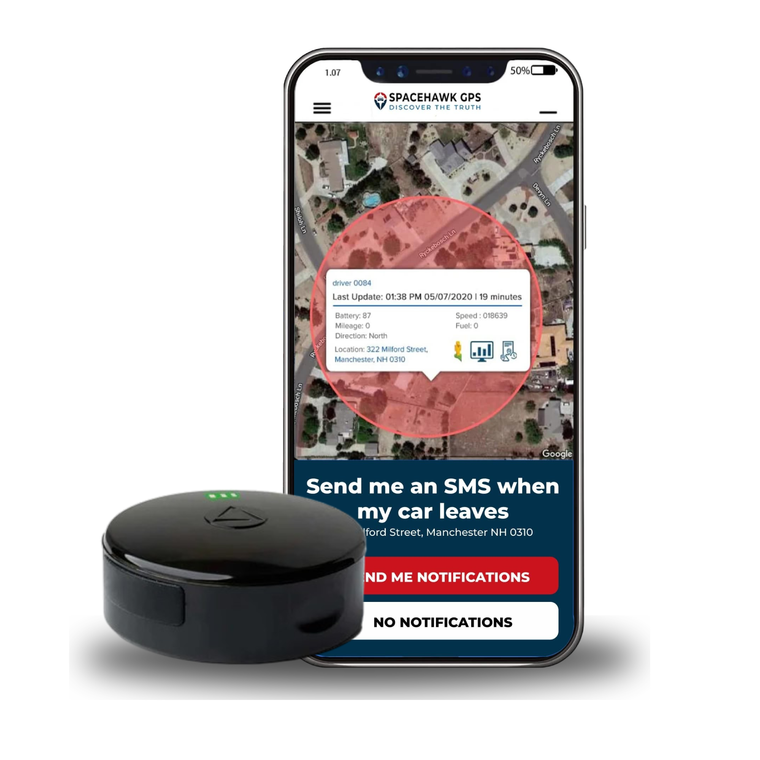
SpaceHawk Magnetic GPS Tracker
Stick it under the car with the built-in magnet and it reports its own location every few seconds from a spot most people never look. Expect weeks per charge, and months in low-power mode.
- 3 second updates
- About 6 ft accuracy
- Magnetic mount
- Waterproof
The First 60 Minutes After Your Car Is Stolen
The clock starts the moment you notice the empty space. What you can show the police in that first hour depends on which device is in the car.
This timeline follows how each device works, not a single theft case, so treat the times as typical.
0 to 5 minutes: you notice the car is gone
- AirTag: The pin shows where an Apple device last saw the tag, often your driveway.
- GPS tracker: A live dot shows where the car is now.
5 to 15 minutes: you check the app
- AirTag: Updates only when someone's Apple device happens by.
- GPS tracker: A route trail updates every 3 to 30 seconds, depending on the model.
15 to 30 minutes: you call the police
- AirTag: You share an old pin that may be hours behind.
- GPS tracker: You share a live location and route.
Step 3 is the one that matters most. Officers can act on a live location far more easily than on a pin that is hours old.
30 to 45 minutes: thieves look for trackers
- AirTag: The tag may beep or trigger phone alerts.
- GPS tracker: Stays silent if well hidden.
45 to 60 minutes: the car stops or changes hands
- AirTag: The trail often goes cold.
- GPS tracker: Pings continue while power and cell signal last.
Give the location to the police, then step back
NICB advises reporting a theft immediately and having the make, model, color, plate number and VIN ready when you call.
Once a tracker gives you a location, hand it to the police and let them handle the recovery. Walking up to a stolen car yourself puts you at risk, and a tracker is meant to keep you away from that moment, not walk you into it.
My advice: open the tracker app once a month, so the first time you use it is not the night you need it.
Hardwired units add one more option. TSD's Hardwired GPS Tracker with Kill Switch can disable the starter from the app, so once the car is parked, the engine will not start until you re-enable it. The limits are worth knowing: the page says it prevents a stolen vehicle from being restarted after shutdown, so it is built to stop a restart, not a car that is already rolling. This model updates as fast as every 30 seconds rather than every 3, it runs $14.95 per month, and professional installation may be needed.
For owners who want that extra layer, this is the model to look at.
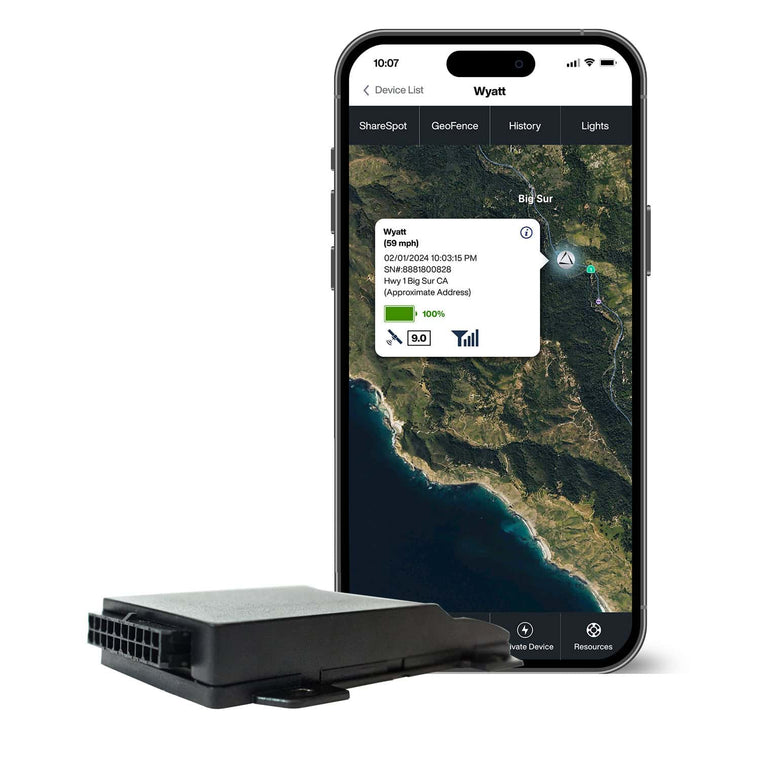
Hardwired GPS Tracker With Kill Switch
Wired into the vehicle's power with a backup battery, it can disable the starter from the app. Updates arrive every 30 seconds. Starter disable stops a restart after shutdown, and professional installation may be needed.
- Remote starter disable
- 30 second updates
- 1 year of route history
- Speed alerts
AirTag vs GPS Tracker Cost Over 3 Years
$29 covers three full years of AirTag ownership, because there is no plan to pay. The bill changes once a cellular plan enters the picture.
The table uses TSD's current sale prices and plan rates for each tracker.
| Option | Upfront | Plan | 3-year total |
|---|---|---|---|
| AirTag | $29 ($99 for four) | None | $29 |
| Battery tracker (SpaceHawk) | $39.95 | From about $9.95 per month* | About $398 |
| OBD2 plug-in (Konnect) | $199.95 | First year included, then $8.95 per month | About $415 |
| Hardwired with kill switch | $249.95 | $14.95 per month | About $788, plus installation if you hire it |
*TSD's SpaceHawk review lists $9.95 per month. The product page says plans start at a low rate that depends on update frequency, and prepaying saves up to 50%.
The math is simple. SpaceHawk is $39.95 plus 36 months at $9.95. Konnect is $199.95 plus 24 months at $8.95, because the first year is included. The hardwired model is $249.95 plus 36 months at $14.95.
Want to skip the monthly fee for the first year? Konnect plugs into the OBD2 port and includes its first full year of service.
See KonnectWant to keep the monthly bill low? Best GPS Tracker for Car With No Monthly Fee shows which trackers include service up front.
Read guideNumbers settle the budget question, but not the choice, so the next step is matching a device to your situation.
Which Should You Buy: AirTag or GPS Tracker?

Buy an AirTag for things you lose, and a GPS tracker for things that can be stolen and driven away.
Among GPS options, OBD2 plug-ins are the easiest to install, magnet-mount units give you the most placement choices, and hardwired units add starter disable. Your situation decides which one fits.
If You Want to Find Lost Keys, Bags or Luggage
The AirTag is the better buy here, and I say that as someone who sells GPS trackers. At $29, with no monthly plan, it does this job well, especially in places full of iPhones like airports and city streets.
Want the tag for your keys or bag? The AirTag runs $29 on Amazon, with no plan to pay.
Buy AirTag on AmazonStolen vehicles are a different problem, and the next pick changes.
If You Want to Recover a Stolen Car
Choose a cellular GPS tracker. Hidden battery units like SpaceHawk give you flexible placement. OBD GPS trackers such as Konnect plug in within seconds, though the OBD2 port is easy for a thief to find too, which is why Konnect sends a tamper alert if it is unplugged.
One more option applies if stopping a theft is worth more to you than tracking it afterward.
If You Want to Stop the Engine From Restarting
Go hardwired. TSD's Hardwired GPS Tracker with Kill Switch costs more, needs wiring, and updates every 30 seconds instead of every 3, but it gives you the one feature the others lack: remote starter disable.
Comparing several car trackers at once? 5 Best Car GPS Tracker puts five tested picks side by side.
Read guidePicking the right device is half the job. Using it well is the other half.
Common Mistakes With AirTags and GPS Trackers
These mistakes are easy to make, and just as easy to fix once you know them. The four below come up the most.
-
01
Trusting an AirTag where few iPhones pass
Rural roads, empty lots and quiet streets at night leave long gaps with no updates.
-
02
Hiding it in the glovebox
The glovebox and cup holders are the first places anyone looks, so choose a hidden placement such as a magnetic mount under the vehicle or wiring behind a panel.
-
03
Forgetting the battery, the plan or the test run
Dead batteries and lapsed plans leave you with a tracker that tells you nothing, and an untested install can fail when you need it most.
-
04
Chasing the car yourself
Share the live location with the police and let them make the recovery.
Fix those four and either device performs much closer to what you paid for.
Not sure where to hide a tracker? 7 Best Hidden GPS Tracker for Car covers covert placements that tested well.
Read guidePut those fixes together and the original question gets an easy answer.
Final Takeaway: Match the Tool to the Theft
In the AirTag vs GPS tracker decision, the AirTag was never meant to protect a car, and that is not its fault. Apple built it to find what you misplace, and it does that well.
Cellular trackers send their own position, so the right choice comes down to placement: hidden under the car, plugged into the OBD2 port, or wired in with starter disable.
After 15 years of installing trackers across the US, I give the same advice every time: use an AirTag for what you misplace, and GPS for what someone can drive away.
Choose the pin that moves.
Ready for a pin that keeps moving?
Remember that frozen pin on a quiet morning? With a cellular tracker, the same morning shows a moving dot, a route, and a location you can hand to the police.
Sources
The facts and figures in this guide come from these sources:
- National Insurance Crime Bureau: U.S. Vehicle Thefts Experience Historic Decline (March 18, 2026)
- National Insurance Crime Bureau: 2023 Vehicle Theft Trends Report
- National Insurance Crime Bureau: Prevent Vehicle Theft
- Apple Support: What to do if you get an alert that an AirTag or other tracker is with you
- MacTrast: Apple unveils second-generation AirTag (January 26, 2026)
- TrackingSystemDirect product pages for SpaceHawk, Konnect and the Hardwired GPS Tracker with Kill Switch
Prices and specs reflect TrackingSystemDirect's product pages at the time of writing.
About the Author


 Buy on Amazon